Public Service Announcement, Radio: AIDS
TINA: Hey, Gina! So I heard that you and Billy have been going steady for a while now.
GINA: Yeah. We love each other. It’s cute.
TINA: So have you had sex yet?!
GINA: Tina!! You know that I made a chastity pledge back in the third grade! You were there!
TINA: Oh, yeah. I remember now. That was a pretty cool ring. The chastity ring, that is. The one that binds you to virginity until marriage, and if you end up deciding to have sex before then that you have to give up. And you can never wear it again. Didn’t your parents pay a lot of money for it? I think they did.
GINA: Yeah. I wear it everyday, and they check to make sure I’m still wearing it everyday. It motivates me to not have sex. But I barely need the motivation in the first place because I have so much support from my family and friends that I barely even think about sex. I’m waiting until I find the perfect person who I will spend the rest of my life with.
TINA: That’s cool. Just don’t be one of the 88 percent of teenage girls who break their chastity vows before marriage, most of which do within a few years!
GINA: Don’t worry! I won’t be!
TINA: I’m glad. You, know, I care a lot about you, Gina, and I just want you to be aware that girls who take chastity pledges are less likely to use condoms and less likely to seek testing and treatment for sexually transmitted diseases, because if they end up giving in to their natural sexual urges, they would rather pretend it isn’t happening, and if it isn’t happening, they see no need to use protection, because that just makes it seem like it is happening.
GINA: Thanks for the tip, Tina! But you don’t have to worry, because I really will never have sex until I’m happily married at the age of 40.
TINA: Me too! We can not worry about contracting HIV/AIDS together! Because, you know, the only for sure way to not have to worry about it is by being sex-free!
GINA: Yeah!… Wait, a minute, Tina—I was already planning on abstinence, but I don’t know all the facts about AIDS. Can you fill me in?
TINA: I could, but here comes Jed. The kid who had sex before he was married. And ended up with human immunodeficiency virus. I’m sure he’d be happy to fill you in!
JED: Hey, guys!
TINA and GINA: Hey, Jed!
GINA: Jed, Tina tells me that you had sex before you were emotionally ready for it and now have HIV. Would you mind telling me about it?
JED: Sure! Yeah. I figure that because I can’t do anything to go back in time and save myself, I might as well go around as a sort of living sexual martyr figure and spread the word of abstinence.
TINA: That’s sooo cool! What a great idea!
JED: It’s the best I can do. Here, let me give you the run-down: You can’t contract AIDS from another person, but you can get HIV, which leads to AIDS, through contact with various bodily fluids, such as blood, semen, vaginal fluid, pre-ejaculate, or breast milk. This majority of HIV/AIDS cases are in result of unprotected sexual relations, when one partner has the disease and their sexual secretion comes into contact with the genital, oral, or rectal mucous membranes of the other partner. This is why it’s better to just wait until you’re married, because if you know that you don’t have HIV, and your partner doesn’t have HIV, and you two are the only ones you have sex with, then you won’t have to worry about contracting the disease.
GINA: Okay… but what happens if you get it? Is it really that bad?
JED: You betcha! What HIV does is it makes the body incredibly and dangerously susceptible to otherwise not-so-harmful infections. That means that what your body could normally handle, now becomes possibly lethal. Personally, I know that I don’t have AIDS yet because I don’t have any of the symptoms. But if you see me with fevers, sweats (particularly at night), swollen glands, chills, weakness, and weight loss, skin rashes, oral ulcerations, and various respiratory infections, you’ll know that I probably have developed AIDS.
TINA: How long will it take you to get AIDS?
JED: Probably between five and eight years, but with some people it takes even longer.
GINA: Can’t you just take medicine to make it go away?
JED: Sadly, no. The scary thing about the epidemic is that as of yet there is no cure.
GINA: That is scary!
JED: Yeah. The only for sure way to prevent it is by preventing exposure to the potential causes. Which is what I’m advising you guys to do. However, there are various medications that are used to reduce the risk of an infection after known exposure. I’m currently taking some of these, and they aren’t very fun, but these antiretroviral treatments reduce both the mortality and the morbidity of the HIV infection, so I’m happy to take them. Unfortunately, these agents are expensive, and the majority of the world's infected individuals do not have access to medications and treatments for HIV and AIDS, making it much more common in poorer areas and countries with higher rates of poverty.
GINA: So that’s why AIDS is such a bigger problem in Africa than in the United States!
TINA: And that’s why you shouldn’t have sex.
JED: Right, but it still is an enormous problem here in the States.
GINA: Oh, yeah, like you.
JED: I’m glad that I could at least tell you guys that the only way to stay safe is to be abstinent, since it’s too late to save myself!
TINA: Boy, I’m sure glad we were lucky enough to have abstinence-only education written into our welfare reform bill 1996. Think how many kids it must have saved already! I’m so afraid of HIV/AIDS that I’m not going to have sex until I’m happily married.
GINA: Me too.
JED: That’s great, guys. I’m glad I could fulfill my role as the sort of living sexual martyr figure and promote abstinence. My work here is done.
Sunday, March 23, 2008

Saturday, March 22, 2008

The Start of a New Student Movement?
The Start of a New Student Movement?
By Adam Sanchez
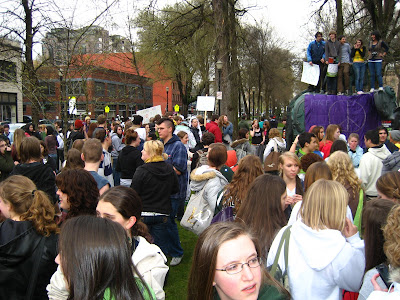
A week of antiwar activities in Portland, Oregon, culminated on Thursday, March 20th with a student walkout that drew over 2,000 students. The larger-than-expected crowd began in the downtown North Park Blocks where students chanted and a couple of rally organizers spoke. Sarah Levy, a Lincoln High School senior and a member of the International Socialist Organization yelled out to the crowd, "We're here today, not because we're mad at our schools, in fact, they're some of the establishments most affected by this war, but because we realize that we aren't being taught what we need in order to end this occupation, and so have learned that we must educate ourselves if we want to make a difference. The goal for today is to reinvigorate the student anti-war movement, and demonstrate through struggle the immense power that we can have as a mass of students."

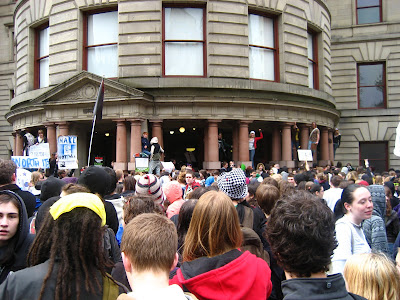
And that, they did. What started out as an unpermitted march on the sidewalks of downtown Portland soon slipped out of the organizers' control as the larger than expected crowd quickly finished the short march route and thousands of high school students, many of whom had never been to a protest before, grew restless and decided to continue the march. The students strode, still on the sidewalks, down to city hall where students began scaling the walls and shouting slogans from the top of the building. A small group of organizers, realizing the moment's potential, began scribbling a list of demands onto a piece of notebook paper. After quickly settling on four demands (funding for schools not the military, no more funding for ROTC programs, all military recruiters out of Portland schools, and making Portland a sanctuary city for GI Resisters), a few of the organizers tried to take them into city hall as the students kept shouting slogans outside. They found the doors locked and the mayor had already left the building to address the crowd. Few protesters could here the mayor's speech, and few seemed to care. The energy of the crowd was far from over.
As the students headed next door to the Wells Fargo building, a number of the organizers managed to swindle a megaphone from the police in exchange for directing the crowd away from much of the downtown traffic. After march organizer, Marko Lamson, spoke about corporate profiteering from the war, the megaphone was used to rattle off the four demands, each one receiving a loud approval from the crowd. But when organizers finished the demands, a number of students in the crowd began yelling for the march to go to Pioneer Square, a central downtown location. This quickly won the approval of the crowd and the march headed to the center of the city. On the way to Pioneer Square police arrested a few students for stepping off the sidewalk, handcuffing one high school student and forcing him into a cop car in front of the crowd. After angry chants of "Let Him Go!", the incident backfired on the police as the protest split into two and took to the streets. I marched with a group who went down Broadway, one of the main Portland arteries and took over two lanes until they reached Pioneer Square. The police, taken by surprise, could not stop the crowd.
At Pioneer Square the group gathered behind the PDX Peace Coalition Banner that read: "Stop the War, Bring the Troops Home Now," and collected money for those who had been arrested and received traffic tickets. The march, now a bit exhausted, headed down to the Willamette River waterfront where they formed a gigantic human peace sign and ended by strolling back up to Portland State University where participants discussed the possibilities for future student organizing.
I have never seen such energy, creativity, and excitement at a protest. Rarely do Portland students get together, unless they are competing against one another for sport. On Thursday, students from over ten different high schools and colleges came together in a stunning display of solidarity against the war. By taking a day out of school to protest the war these students were able to educate themselves and those around them about something most rarely feel—the potential of protest to shake up a city. By the end of the day there were about 30 cops on horses, another 30 on bikes, 30 on motorcycles, 20 or so police cars, and a helicopter, all trying to figure out what was going to happen next and arrest any leader they could find. But the movement was organic, spontaneous and difficult for even the organizers to control. It revealed that students were angry and no longer willing to let politicians continue to cut funding for education while spending exorbitant amounts on the military. This protest was an inspiration, not just to students, but to long-time activists as well, many of whom had never seen such an outburst of mass spontaneity.
By Adam Sanchez
A week of antiwar activities in Portland, Oregon, culminated on Thursday, March 20th with a student walkout that drew over 2,000 students. The larger-than-expected crowd began in the downtown North Park Blocks where students chanted and a couple of rally organizers spoke. Sarah Levy, a Lincoln High School senior and a member of the International Socialist Organization yelled out to the crowd, "We're here today, not because we're mad at our schools, in fact, they're some of the establishments most affected by this war, but because we realize that we aren't being taught what we need in order to end this occupation, and so have learned that we must educate ourselves if we want to make a difference. The goal for today is to reinvigorate the student anti-war movement, and demonstrate through struggle the immense power that we can have as a mass of students."

And that, they did. What started out as an unpermitted march on the sidewalks of downtown Portland soon slipped out of the organizers' control as the larger than expected crowd quickly finished the short march route and thousands of high school students, many of whom had never been to a protest before, grew restless and decided to continue the march. The students strode, still on the sidewalks, down to city hall where students began scaling the walls and shouting slogans from the top of the building. A small group of organizers, realizing the moment's potential, began scribbling a list of demands onto a piece of notebook paper. After quickly settling on four demands (funding for schools not the military, no more funding for ROTC programs, all military recruiters out of Portland schools, and making Portland a sanctuary city for GI Resisters), a few of the organizers tried to take them into city hall as the students kept shouting slogans outside. They found the doors locked and the mayor had already left the building to address the crowd. Few protesters could here the mayor's speech, and few seemed to care. The energy of the crowd was far from over.

As the students headed next door to the Wells Fargo building, a number of the organizers managed to swindle a megaphone from the police in exchange for directing the crowd away from much of the downtown traffic. After march organizer, Marko Lamson, spoke about corporate profiteering from the war, the megaphone was used to rattle off the four demands, each one receiving a loud approval from the crowd. But when organizers finished the demands, a number of students in the crowd began yelling for the march to go to Pioneer Square, a central downtown location. This quickly won the approval of the crowd and the march headed to the center of the city. On the way to Pioneer Square police arrested a few students for stepping off the sidewalk, handcuffing one high school student and forcing him into a cop car in front of the crowd. After angry chants of "Let Him Go!", the incident backfired on the police as the protest split into two and took to the streets. I marched with a group who went down Broadway, one of the main Portland arteries and took over two lanes until they reached Pioneer Square. The police, taken by surprise, could not stop the crowd.

At Pioneer Square the group gathered behind the PDX Peace Coalition Banner that read: "Stop the War, Bring the Troops Home Now," and collected money for those who had been arrested and received traffic tickets. The march, now a bit exhausted, headed down to the Willamette River waterfront where they formed a gigantic human peace sign and ended by strolling back up to Portland State University where participants discussed the possibilities for future student organizing.
I have never seen such energy, creativity, and excitement at a protest. Rarely do Portland students get together, unless they are competing against one another for sport. On Thursday, students from over ten different high schools and colleges came together in a stunning display of solidarity against the war. By taking a day out of school to protest the war these students were able to educate themselves and those around them about something most rarely feel—the potential of protest to shake up a city. By the end of the day there were about 30 cops on horses, another 30 on bikes, 30 on motorcycles, 20 or so police cars, and a helicopter, all trying to figure out what was going to happen next and arrest any leader they could find. But the movement was organic, spontaneous and difficult for even the organizers to control. It revealed that students were angry and no longer willing to let politicians continue to cut funding for education while spending exorbitant amounts on the military. This protest was an inspiration, not just to students, but to long-time activists as well, many of whom had never seen such an outburst of mass spontaneity.
Student Revolution, March 20: Why We Did It
The Costs of War on Education and Why We Must Voice Our Dissent
We’re here today, not because we’re mad at our schools, (in fact, they’re some of the establishments most affected by this war), but because we realize that we aren’t being taught what we need in order to end this occupation, and so have learned that we must educate ourselves if we want to make a difference. Another goal for today is to reinvigorate the student anti-war movement, and demonstrate through struggle the immense power that we can have as a mass of students.
In recent years, it seems student activism has died down. Although the sentiment’s still there—kids still think we shouldn’t be in Iraq—we just seem to have come to terms with the idea that as students, we can’t make any difference on U.S. policy. So go join a Facebook group proclaiming your views. “1 Million Against the War in Iraq.” “No More War.” But lord knows actually doing something won’t make a difference, so why bother?
I know that in the past I, and probably many of you, have felt isolated in this frustration about what our country has been doing in the “name of democracy.” But look around you now. And just see how many other people your age feel the same way. What we need to do is act together to put forward a booming anti-war voice that can be heard across the country that will not only inspire other students to voice their dissent, and act upon it, but hopefully inspire adults as well, and eventually get the entire country up in arms about what is being done in our name, and with our tax dollars, so that we can not be ignored.
So going back to how our schools have been horribly affected by this war: let me illustrate for you the reason why many public schools suffer from budget cuts, and less and less teachers, and larger classes… you know the jist. According to the Congressional Research Office, looking at the Federal Discretionary Budget, whereas the United States spends between 57 and 60 percent of its budget on the military, only around 8 percent of this budget is spent on education, training, and social services combined! That’s about one tenth as much, being spend on education. So that means that the reason there isn’t the funding for teachers to make a decent wage, or to have classes of less than 30 people, or to have full-fledged music programs in our schools, is because that money is going towards building up weapons and destroying another country. What a good deal for everybody.
Another way to look at it is if you think about just how much we are spending on this war. According to Nobel Prize-winning economist, Joseph Stiglitz, the Iraq war has cost us more than $1 trillion in just the first four years. In the time it will take me to say this sentence, $250,000 will have been spent on the Iraq war. That’s $720 million every day. Do you know what $720 million dollars could pay for in just one day? To all you seniors out there, that number represents 34,904 four-year scholarships for university students. Paid in one day. But it also could fund 12,478 elementary school teachers. Or 84 entire new elementary schools. Over 1 million free school lunches, paid in one single day. But instead of these good causes, it’s being used to ruin the lives of Iraqis.
Not only are we putting our own education in a tight squeeze, but we have made it nearly impossible for Iraqis (and Syrians) to get an education at all. It’s hardly safe for Iraqis to leave their homes, let alone go to school, and with the amount of refugees fleeing to Syria as well as Jordan, Egypt, Iran, and Lebanon, (about 2.5 million total) each of these countries’ own school systems are becoming more and more crunched as they accumulate more and more students with no additional funds.
You may still think that protesting won’t make any difference. But if you look back 40 years, in the Vietnam war, it was only after repeated years of enormous protests, some with half-a-million people, that the GIs finally felt the courage from the support of their country, to revolt against what they were being forced to do. We need to show the troops that though we support them, we do not support what our government is telling them to do. Only once they see that their country—their friends, parents, brothers and sisters—do not agree with what they are doing, will they gain the will and strength to fight back.
This is why we need to step up the action.
It doesn’t work to just focus all your energy into an election and be done. We can’t leave these crucial decisions about what we do or do not do in other countries in the hands of a few people at the top. We have to keep fighting for what we know is right and just, and make sure that our elected officials stand up to what they promise us. We have to demand that troops leave Iraq. This is not a war. There is no Iraqi army that we are legitimately fighting against. This is an occupation. And you can’t win an occupation. You just have to leave.
We have to start an ongoing discussion, and educate ourselves about the side of the war that is not told in common media. I urge you to talk with you friends, talk with your parents, make Iraq a common topic for discussion. We have to educate ourselves and spread the truth so that more people will feel a need for something to be done, if we want this war to end in the near future.
We’re here today, not because we’re mad at our schools, (in fact, they’re some of the establishments most affected by this war), but because we realize that we aren’t being taught what we need in order to end this occupation, and so have learned that we must educate ourselves if we want to make a difference. Another goal for today is to reinvigorate the student anti-war movement, and demonstrate through struggle the immense power that we can have as a mass of students.
In recent years, it seems student activism has died down. Although the sentiment’s still there—kids still think we shouldn’t be in Iraq—we just seem to have come to terms with the idea that as students, we can’t make any difference on U.S. policy. So go join a Facebook group proclaiming your views. “1 Million Against the War in Iraq.” “No More War.” But lord knows actually doing something won’t make a difference, so why bother?
I know that in the past I, and probably many of you, have felt isolated in this frustration about what our country has been doing in the “name of democracy.” But look around you now. And just see how many other people your age feel the same way. What we need to do is act together to put forward a booming anti-war voice that can be heard across the country that will not only inspire other students to voice their dissent, and act upon it, but hopefully inspire adults as well, and eventually get the entire country up in arms about what is being done in our name, and with our tax dollars, so that we can not be ignored.
So going back to how our schools have been horribly affected by this war: let me illustrate for you the reason why many public schools suffer from budget cuts, and less and less teachers, and larger classes… you know the jist. According to the Congressional Research Office, looking at the Federal Discretionary Budget, whereas the United States spends between 57 and 60 percent of its budget on the military, only around 8 percent of this budget is spent on education, training, and social services combined! That’s about one tenth as much, being spend on education. So that means that the reason there isn’t the funding for teachers to make a decent wage, or to have classes of less than 30 people, or to have full-fledged music programs in our schools, is because that money is going towards building up weapons and destroying another country. What a good deal for everybody.
Another way to look at it is if you think about just how much we are spending on this war. According to Nobel Prize-winning economist, Joseph Stiglitz, the Iraq war has cost us more than $1 trillion in just the first four years. In the time it will take me to say this sentence, $250,000 will have been spent on the Iraq war. That’s $720 million every day. Do you know what $720 million dollars could pay for in just one day? To all you seniors out there, that number represents 34,904 four-year scholarships for university students. Paid in one day. But it also could fund 12,478 elementary school teachers. Or 84 entire new elementary schools. Over 1 million free school lunches, paid in one single day. But instead of these good causes, it’s being used to ruin the lives of Iraqis.
Not only are we putting our own education in a tight squeeze, but we have made it nearly impossible for Iraqis (and Syrians) to get an education at all. It’s hardly safe for Iraqis to leave their homes, let alone go to school, and with the amount of refugees fleeing to Syria as well as Jordan, Egypt, Iran, and Lebanon, (about 2.5 million total) each of these countries’ own school systems are becoming more and more crunched as they accumulate more and more students with no additional funds.
You may still think that protesting won’t make any difference. But if you look back 40 years, in the Vietnam war, it was only after repeated years of enormous protests, some with half-a-million people, that the GIs finally felt the courage from the support of their country, to revolt against what they were being forced to do. We need to show the troops that though we support them, we do not support what our government is telling them to do. Only once they see that their country—their friends, parents, brothers and sisters—do not agree with what they are doing, will they gain the will and strength to fight back.
This is why we need to step up the action.
It doesn’t work to just focus all your energy into an election and be done. We can’t leave these crucial decisions about what we do or do not do in other countries in the hands of a few people at the top. We have to keep fighting for what we know is right and just, and make sure that our elected officials stand up to what they promise us. We have to demand that troops leave Iraq. This is not a war. There is no Iraqi army that we are legitimately fighting against. This is an occupation. And you can’t win an occupation. You just have to leave.
We have to start an ongoing discussion, and educate ourselves about the side of the war that is not told in common media. I urge you to talk with you friends, talk with your parents, make Iraq a common topic for discussion. We have to educate ourselves and spread the truth so that more people will feel a need for something to be done, if we want this war to end in the near future.
Friday, February 15, 2008
Eskimo & Sons do 'Mediated'
"2012"; by Eskimo & Sons
They put the women with white teeth
Inside every TV screen.
They said expect some rain
But a tidal wave ca-a-ame.
Oh oh, oh-oh.
And everything I swallowed up
In the greatest aquarium
But the seahawks drowned
And the fish turned upside down.
Oh-oh, whoa-oh.
So we'll mail wood in your windows
And we'll make sales from shirts and your
And we will put you up
You and who you lo-o-ove
This house is a home, a home is your-ours
A great song. Not only does [at least the first stanza] infer that the apocalypse will have to do with television and artificially white teeth, but it uses deZengotita's reference to "comparing a wind to a hurricane."
Genre: Angelic Post-Rock
They put the women with white teeth
Inside every TV screen.
They said expect some rain
But a tidal wave ca-a-ame.
Oh oh, oh-oh.
And everything I swallowed up
In the greatest aquarium
But the seahawks drowned
And the fish turned upside down.
Oh-oh, whoa-oh.
So we'll mail wood in your windows
And we'll make sales from shirts and your
And we will put you up
You and who you lo-o-ove
This house is a home, a home is your-ours
A great song. Not only does [at least the first stanza] infer that the apocalypse will have to do with television and artificially white teeth, but it uses deZengotita's reference to "comparing a wind to a hurricane."
Genre: Angelic Post-Rock
The War Will Not Be Televised
"Never forget that everything Hitler did in Germany was legal."
-Martin Luther King Jr.
Friday, February 8, 2008
The Media Is Lying To You About Iraq
Unless you're living in a cave, you probably don't think the war's recently been all that successful.
'But we can't leave,' you'll say. 'I know we aren't necessarily causing dramatic good, but just think how horrendously things would escalate if we were to simply get up and go!!'
I tell you, this is the Blob speaking.
The common sentiment that "if the U.S. leaves Iraq, the violent sectarianism between the Sunni and Shia will worsen" is exactly what Republicans and Democrats want us to believe so they can "justify the continuance of the occupation of Iraq" (Dahr Jamail). This entire conception of an intense hatred between the sects has actually been manufactured and played up out of an unprofessional ignorance of culture by our leading officials, and so that the war can be more easily spoon-fed to Americans. Jamail continues, "This propaganda, like others of its ilk, gains ground, substances, and reality due largely to the ignorance of those ingesting it. The snow job by the corporate media on the issue of sectarianism in Iraq has ensured that the public buys into the line that the Sunni and Shia will dice one another up into little pieces if the occupation ends."
In reality, "prior to the Anglo-American invasion and occupation of Iraq there had never been open warfare between the two groups and centainly not a civil war." When Dahr Jamail was in Iraq in 2003, he quickly learned of the grand faux-paus it was to ask someone of their sect. When asked, the most common response (after an awkward look that told you how rude the question was,) would be, "I am Muslim," or "I am Iraqi." Further demonstrating this was the amount of intermarriages between the sects, mixed neighborhoods, and even Shia and Sunni praying in the same mosques. Quite contrary to how our media would have it depicted...
However, as soon as Americans went in, they assumed that the country was strictly divided and went on to create their own Iraqi puppet government that was numerically based on the break-down of the percentages of Sunni, Shia, and Kurds (and "for good measure, a couple of Turkoman and Christian") representatives, so we could prove just how "democratic" we really were and wanted Iraq to be. (It is important to note that when the U.S. military commander showed up and asked these Iraqi tribal and religious leaders to divide themselves by sect, they were "utterly perplexed" by the oddity of his request.)
Much later, "U.S.-backed sectarian death squads have become the foremost generator of death in Iraq, even surpassing the U.S. military machine." The U.S. military has been known to let "Iraqi police" and "Iraqi army" personnel "masked in black balaclavas, through their checkpoints to carry out abductions and assassinations in the neighborhoods. But when we get the word back home, these men are referred to as "concerned local citizens," or simply "volunteers."
Consequent to what we have birthed, "almost all of Baghdad and much of Iraq is now segregated." Although we are constantly told that the violence has lessened, the truth is that that "all that has happened is a dramatic change in the demographic map of Iraq," that because of us, "Baghdad is a divided city."
Yeah, but even so! We can't evacuate! Iraq would descend further into a sectarian nightmare! And we would be to blame! (Just to refresh- where did we get this idea? Oh, right- from what we've been reading.)
The one example that shows what would likely be expected if we did leave (that the media doesn't want you to know about) is from early September. This was when "500 British troops left one of Saddam Hussein's palaces in the heart of the city and ceased to conduct regular food patrols." And just what was the result? "According to the British military, the overall level of violence in the city has DECREASED BY 90 PERCENT since then."
No WONDER we haven't left yet... (?)
As Jamail concludes, although this obviously can't be guaranteed, "it does prove that when the primary cause of the violence, sectarian strife, instability, and chaos is removed from the equation of Iraq, things are bound to improve rapidly."
Are you still going to believe that we're what's holding Iraq together?
(All quotes come from Dahr Jamail's article, "The myth of sectarianism," out of the current issue of the ISR. Dahr Jamail is an independent journalist who spend eight months in Iraq and is the author of "Beyond the Green Zone: Dispatches From an Unembedded Journalist in Occupied Iraq")
'But we can't leave,' you'll say. 'I know we aren't necessarily causing dramatic good, but just think how horrendously things would escalate if we were to simply get up and go!!'
I tell you, this is the Blob speaking.
The common sentiment that "if the U.S. leaves Iraq, the violent sectarianism between the Sunni and Shia will worsen" is exactly what Republicans and Democrats want us to believe so they can "justify the continuance of the occupation of Iraq" (Dahr Jamail). This entire conception of an intense hatred between the sects has actually been manufactured and played up out of an unprofessional ignorance of culture by our leading officials, and so that the war can be more easily spoon-fed to Americans. Jamail continues, "This propaganda, like others of its ilk, gains ground, substances, and reality due largely to the ignorance of those ingesting it. The snow job by the corporate media on the issue of sectarianism in Iraq has ensured that the public buys into the line that the Sunni and Shia will dice one another up into little pieces if the occupation ends."
In reality, "prior to the Anglo-American invasion and occupation of Iraq there had never been open warfare between the two groups and centainly not a civil war." When Dahr Jamail was in Iraq in 2003, he quickly learned of the grand faux-paus it was to ask someone of their sect. When asked, the most common response (after an awkward look that told you how rude the question was,) would be, "I am Muslim," or "I am Iraqi." Further demonstrating this was the amount of intermarriages between the sects, mixed neighborhoods, and even Shia and Sunni praying in the same mosques. Quite contrary to how our media would have it depicted...
However, as soon as Americans went in, they assumed that the country was strictly divided and went on to create their own Iraqi puppet government that was numerically based on the break-down of the percentages of Sunni, Shia, and Kurds (and "for good measure, a couple of Turkoman and Christian") representatives, so we could prove just how "democratic" we really were and wanted Iraq to be. (It is important to note that when the U.S. military commander showed up and asked these Iraqi tribal and religious leaders to divide themselves by sect, they were "utterly perplexed" by the oddity of his request.)
Much later, "U.S.-backed sectarian death squads have become the foremost generator of death in Iraq, even surpassing the U.S. military machine." The U.S. military has been known to let "Iraqi police" and "Iraqi army" personnel "masked in black balaclavas, through their checkpoints to carry out abductions and assassinations in the neighborhoods. But when we get the word back home, these men are referred to as "concerned local citizens," or simply "volunteers."
Consequent to what we have birthed, "almost all of Baghdad and much of Iraq is now segregated." Although we are constantly told that the violence has lessened, the truth is that that "all that has happened is a dramatic change in the demographic map of Iraq," that because of us, "Baghdad is a divided city."
Yeah, but even so! We can't evacuate! Iraq would descend further into a sectarian nightmare! And we would be to blame! (Just to refresh- where did we get this idea? Oh, right- from what we've been reading.)
The one example that shows what would likely be expected if we did leave (that the media doesn't want you to know about) is from early September. This was when "500 British troops left one of Saddam Hussein's palaces in the heart of the city and ceased to conduct regular food patrols." And just what was the result? "According to the British military, the overall level of violence in the city has DECREASED BY 90 PERCENT since then."
No WONDER we haven't left yet... (?)
As Jamail concludes, although this obviously can't be guaranteed, "it does prove that when the primary cause of the violence, sectarian strife, instability, and chaos is removed from the equation of Iraq, things are bound to improve rapidly."
Are you still going to believe that we're what's holding Iraq together?
(All quotes come from Dahr Jamail's article, "The myth of sectarianism," out of the current issue of the ISR. Dahr Jamail is an independent journalist who spend eight months in Iraq and is the author of "Beyond the Green Zone: Dispatches From an Unembedded Journalist in Occupied Iraq")
Subscribe to:
Comments (Atom)
